
Are You Participating or Contributing?
The difference between occupying a board seat and adding boardroom value
Most directors take their responsibilities seriously. They read the materials, attend meetings and ask questions. But these activities are only the starting point of effective director contribution.
A board can have highly capable people around the table and still underperform. Current governance guidance emphasizes that effective directors provide strategic guidance and constructive challenge, while remaining collectively responsible for the board’s decisions. Recent director surveys also point to increasing expectations for individual accountability and ongoing development. Thus the goal is for directors to be more than present and prepared. Their participation should improve the board’s judgment.
The strongest contributions help the board understand the issue, test important assumptions, consider alternatives and reach a sound decision.
Consider the difference:
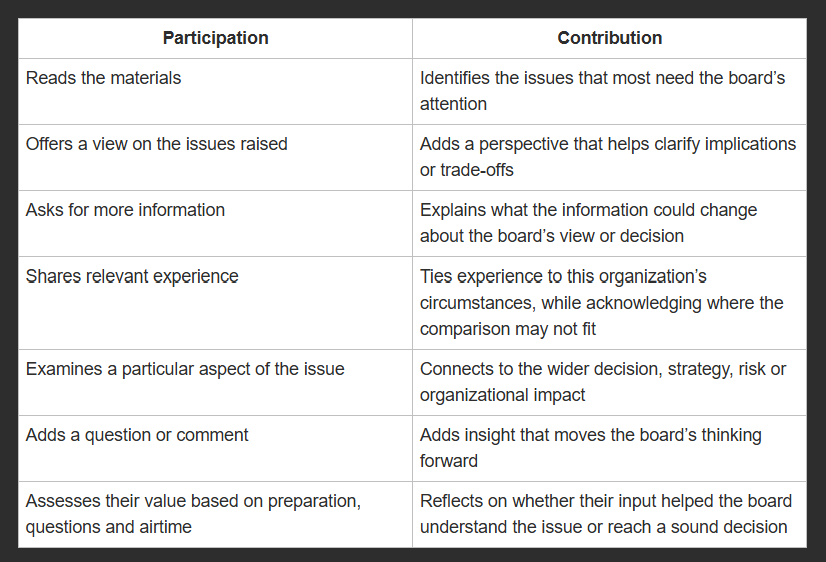
How can directors move from participation toward contribution?
1. Prepare for the discussion, not only the content.
After reading the materials, identify the two or three matters that deserve board attention. Ask: How does this advance our goals? What could materially affect the organization? Where could the board’s judgment make a difference?
2. Connect questions to their purpose.
Before asking for additional information, consider what you would do differently depending on the answer. If the response would not affect the board’s oversight, advice or decision, the question may be interesting, but not material.
3. Build rather than repeat.
Listen for what the discussion still needs. That might be a missing perspective, an untested assumption, a connection to strategy or risk, or a clear articulation of the trade-off. Effective contribution is cumulative, moving the board’s collective thinking forward.
4. Use experience without making it the answer.
Relevant experience can illuminate an issue, but another organization’s solution may not fit the current context. Offer experience as a lens or question, not as proof that management should follow the same path.
5. Review your contribution after the meeting.
After each meeting, ask: Where did I improve the board’s understanding or judgment? Where did I consume airtime without moving the discussion forward?
As a director, you have an opportunity to make a valuable contribution. Use it well.